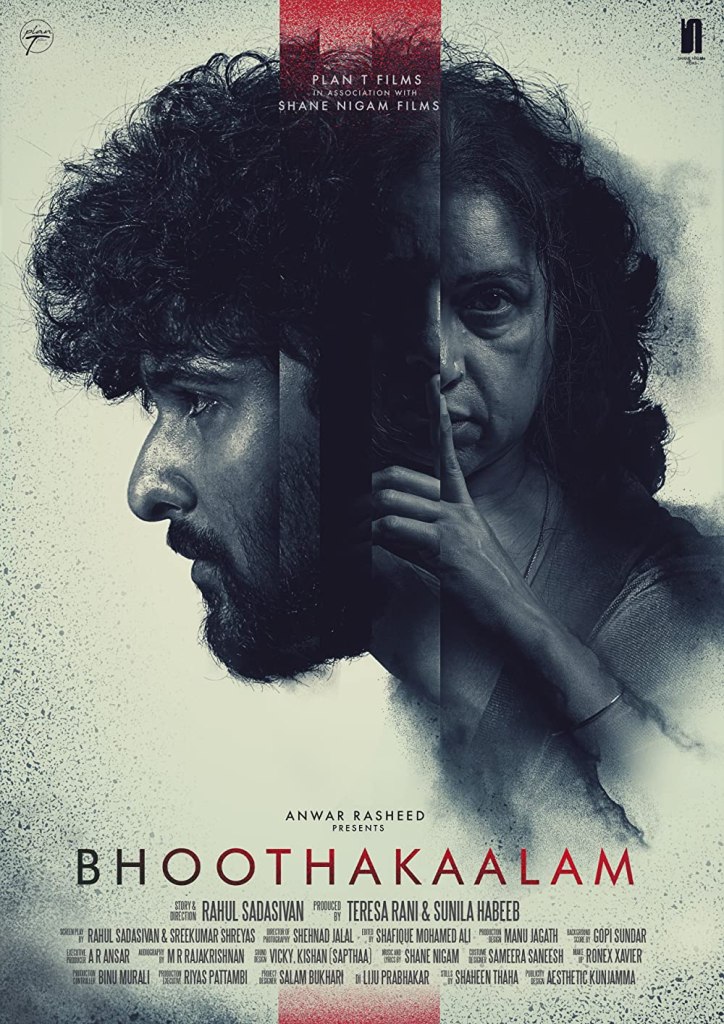
Bhoothakaalam is as terrifying as it is clever, a horror drama that is impossible to pin down as being a psychological thriller or a paranormal thriller. It is either or both, depending on how you wish to view it. Neither the title nor the finale provides a spoon-fed answer.
The word bhoothakaalam means “the past” or “past tense”, but it could as well be interpreted as “the age of spirits”. Take your pick.
The games in this film are being played as much in a viewer’s mind as in the goings-on on screen, which of course is how it is in any good suspense story, but in this one more than most.
Written and directed by Rahul Sadasivan, Bhoothakaalam revolves largely around a mother and son living together in a house in urban Kerala, haunted by a troubled past and present-day turmoil. She, Asha, is a schoolteacher and is undergoing treatment for clinical depression. He, Vinu, is a frustrated unemployed graduate.
They love each other but have allowed their stresses, resentments and bitterness to fester for years. Soon, unnerving night-time occurrences in the house further disrupt their existence.
The film initially conveys the impression that it will follow oft-visited scary movie conventions – loud music, sudden movements – but don’t be misled. Cinematographer Shehnad Jalal’s framing, the background score by Gopi Sundar and Shafique Mohamed Ali’s editing for Bhoothakaalam are far from formulaic. Their weapons are taken from an existing arsenal, but the way they employ them is outstanding. Vicky and Kishan’s sound design is notable for its use of silences, which is unusual for an Indian thriller.
With this assembly of talents at work, the tension in Bhoothakaalam gradually builds up as the narrative gathers momentum, and stray clues to what might possibly be happening are scattered throughout the plot, until the dramatic interval point after which chills pile up on chills, all leading up to an unrelenting, elongated and frightening climax.
Revathy has such mastery over her craft that she makes her fears entirely our fears and does not appear to strain a single extra nerve even when the camera gets so close to her that it looks set to bore into her skin. It is the Malayalam film industry’s great loss that, despite its apparent progressiveness, it gives this wonderful actor so few parts because of its preoccupation with men’s stories featuring youthful women on the margins.
Shane has so far worked in some smashing films of the ongoing Malayalam New New Wave. He was excellent in Kismath, Eeda and Kumbalangi Nights. Here, he confidently matches up to Revathy, with his fatigue, his distress and his pain etched into his face and his demeanour.
By dwelling on mental health at length, it does more than most Indian language cinemas do, but it is not as lucid as most Malayalam films these days are about psychiatry and the treatment of ailments of the mind, especially when it does not address the irresponsibility shown by Asha’s doctor (Gilu Joseph) and in its fuzziness over Saiju Kurup’s character’s area of expertise.
Through all this, Bhoothakaalam’s focus never strays from its goal of terrorising the audience.

 Film Talkies